In my ongoing reincarnation research, one theme keeps surfacing again and again: the way gifts, talents, and creative callings ripple through time. Just as faces carry echoes of where a soul has been before (see the Facial & Soul Recognition page), and just as lives sometimes overlap or interweave in complex patterns (explored further on the Layered Lives page), so too do our abilities seem to carry a continuity that defies linear history.
Astrological charts often mirror this same phenomenon: placements repeating, karmic lessons resurfacing, or a North Node pointing toward a path the soul has walked before in another form. My articles for Brainz Magazine explore these patterns further, showing how reincarnation research can be approached with both intuitive sensitivity and structural clarity.
Even contemporary research is beginning to circle these mysteries. Michael Levin’s recent paper Ingressing Minds: Causal Patterns Beyond Genetics and Environment in Natural, Synthetic, and Hybrid Embodiments (2025) suggests that memory and talent might not be bound only to DNA or circumstance, but could ingress from a wider, non-physical field. In Reality Cult language: the soul field. What I find in readings and what Levin maps scientifically seem to rhyme—suggesting that gifts and callings may be “imported” through channels older and wider than biology.
This page offers portraits of people paired with their found past-life counterparts—each example highlighting not just resemblance, but the living thread of a soul’s vocation. A healer becomes a teacher, a performer becomes a guide, an artist finds new mediums but the same burning creative spark.
What emerges is a larger story: that our work today is rarely a true beginning. It is often a continuation—a soul apprenticeship that spans centuries.
Every talent is a remembrance. Every gift is an echo.
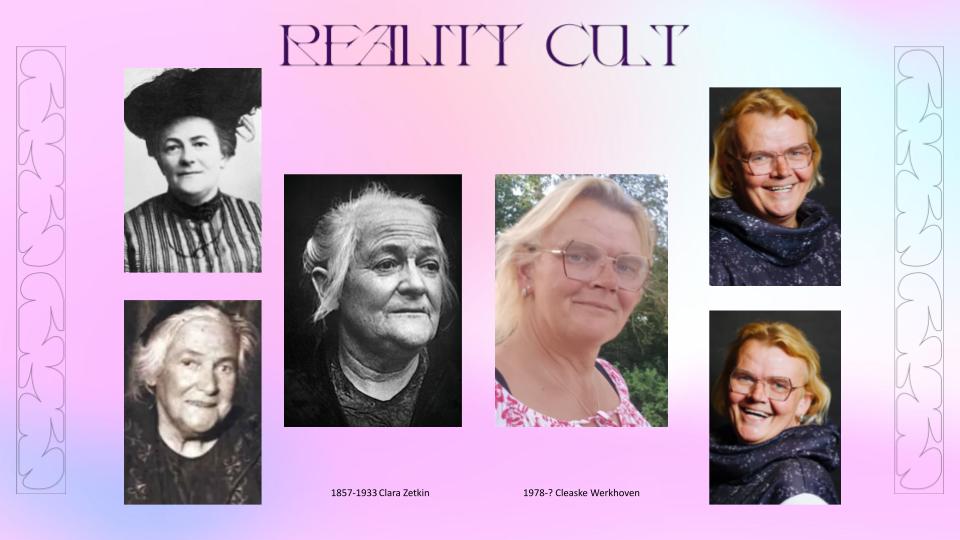
Clara Zetkin → Cleaske Werkhoven
There is something deeply brave in the spirit of Clara Zetkin: organizing, speaking truth, and standing against state systems that oppressed women, workers, and political dissidents. A century later, this same energy finds resonance in the life of Cleaske Werkhoven.
Cleaske is a Dutch transgender woman who survived decades of addiction and now stands as a role model in both the transgender and sober communities. Her voice has also become vital in exposing the toeslagenaffaire—a scandal in which thousands of families were falsely accused of fraud, stripped of their benefits, and left financially and socially devastated by the Dutch tax authority. In many ways, this mirrors Zetkin’s own lifelong battle against the crushing weight of unjust state power.
Both women transformed their pain into advocacy: Zetkin building political movements for women’s rights and workers’ dignity; Cleaske speaking openly about addiction, identity, and systemic abuse, creating visibility for those too often silenced. Each risked their personal safety and well-being to bring collective wounds into the light.
The echo here is unmistakable: a soul that repeatedly rises against structures of injustice, carrying the task of turning victimhood into courage, and suffering into solidarity.
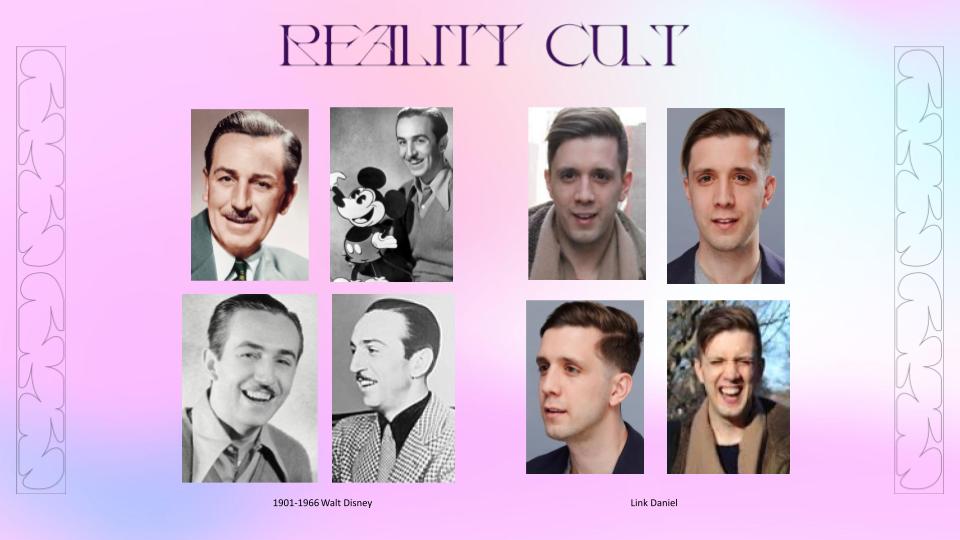
Walt Disney → Link Daniel
The soul of Walt Disney carried a gift for building worlds—imaginary landscapes that could be entered, inhabited, and collectively dreamed. Through animation and storytelling, Disney gave the 20th century a mythology of wonder, innocence, and imagination, constructing cultural architectures that shaped how generations envisioned possibility.
In this lifetime, that same creative current flows through Link Daniel, founder of Network, a project designing a network for dream exploration. Where Disney built cinematic and physical dreamscapes, Link builds technological ones: an open, decentralized system that allows individuals to explore consciousness, liberate themselves from mental loops, and co-create shared spaces of imagination.
Both embody the archetype of dream architect—designers of portals where people can step outside ordinary reality and into new dimensions. Disney’s tools were film reels and theme parks; Link’s are decentralized protocols, neural networks, and collective experiments in consciousness.
The echo is clear: across centuries, the soul’s work remains to open doors of imagination, to build infrastructures for dreaming—whether through art, story, or technology.
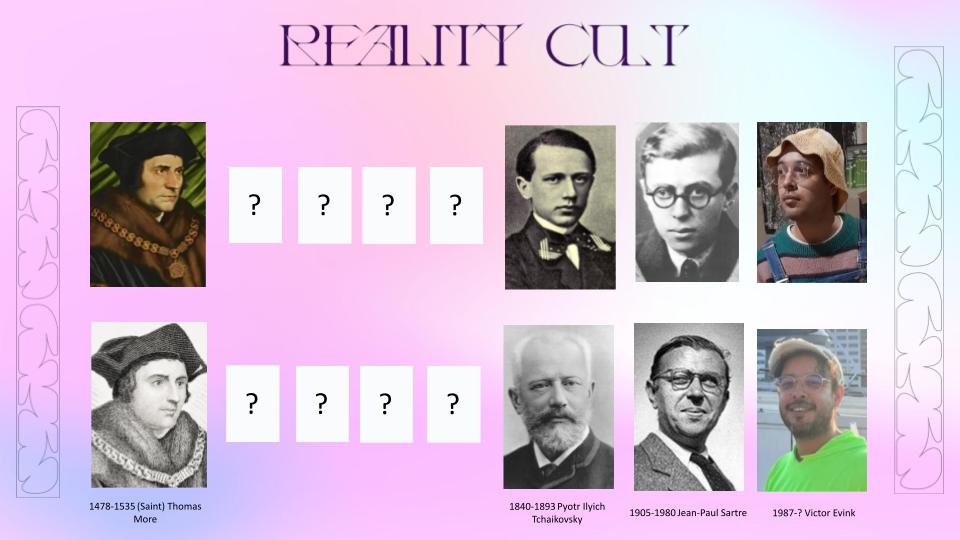
Pyotr Ilyich Tchaikovsky → Jean-Paul Sartre → Victor Evink
This soul line moves from emotional depth to philosophical inquiry to world-building, always with a sensitivity toward what is hidden, what is felt, and what could be imagined differently.
Tchaikovsky (1840–1893) embodied intensity and longing through music—romantic, dramatic, and emotionally charged compositions that gave voice to the interior.
Sartre (1905–1980) translated that inner turbulence into philosophy, exploring freedom, authenticity, and existential struggle—shaping the 20th century’s way of thinking about being and choice.
In this life, as Victor Evink, the same current manifests in a multitalented artist, thinker, writer, and world-builder. Together with his creative partner Emilia Tapprest—who in past lives echoes Simone de Beauvoir—Victor co-founded Liminal.Vision, a collective platform for speculative design and storytelling. Through projects like Sonzai Zone, Zhouwei Network, and Interfaces, they build alternative worlds, imagine “affective atmospheres,” and prototype future societies—exploring how perception, technology, and relational design can open new collective possibilities.
Beyond Liminal.Vision, Victor develops projects like EtherAxis, a speculative game for co-imagining futures; publishes essays through Wonders of Work; and contributes to experimental initiatives at Mediamatic.
From Tchaikovsky’s emotional architecture to Sartre’s existential depth, and now into Victor’s speculative world-building, the continuity is clear: a soul continually called to translate inner intensity into shared spaces—where imagination itself becomes a prototype for freedom.
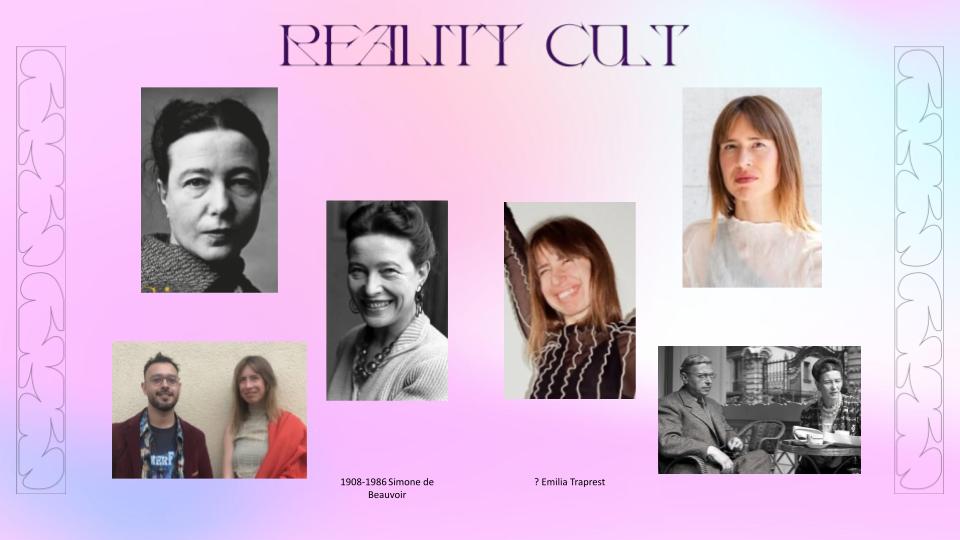
Simone de Beauvoir → Emilia Tapprest
This soul line carries inquiry, existential courage, and the co-creation of bold futures.
Simone de Beauvoir (1908–1986) was a philosopher, writer, and feminist whose work challenged conventions, interrogated identity, and insisted on the freedom of becoming. In The Second Sex, The Mandarins, and her essays, she wove together personal, political, and philosophical threads—arguing that existence precedes essence, and that we are never fully determined but always in becoming.
In this life as Emilia Tapprest, that same thread emerges in art, research, and world-building. Emilia is a multidisciplinary artist and co-director of Nvisible Studio, where she works in speculative practice, immersive installations, relational design, visual art, and creative research. Her artist-residence work (see IAS UvA) shows her exploring visibility/invisibility, identity, presence, and absence. Through nvisible.studio her mission comes into view: to create environments that hold ambiguity, probe what it means to be seen, and co-imagine subtle, relational futures.
Emilia’s creative partnership with Victor Evink (echoed by Beauvoir’s own partnership with Sartre) further amplifies this soul pattern: together they build alternative worlds (through their work with Liminal.Vision), imagine “affective atmospheres,” prototype future societies, and explore how identities, neurodiversity, and relationality shape perception and design. Her artistic voice is one that questions what is normative, what is hidden, and what can be made visible through art and experience.
Across lifetimes, this soul’s task is consistent: to interrogate, resist, and re-invent the boundaries between identity and freedom—to hold the tension between self and world, and to manifest spaces where people can both question and become.
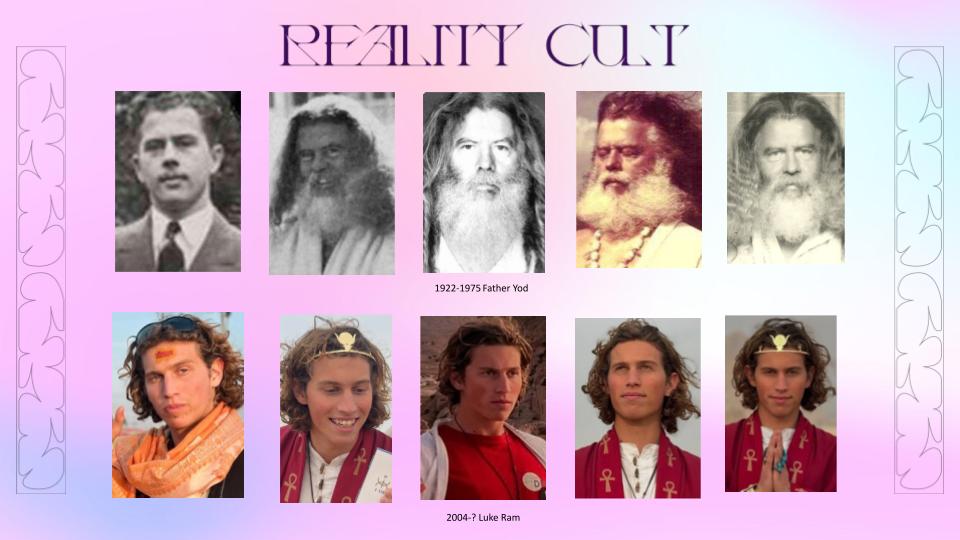
Father Yod → Luke Ram
This soul thread carries the archetype of the spiritual experimenter: one who creates living rituals where food, art, and community become sacraments.
Father Yod (1922–1975) founded the Source Family in Los Angeles, a radical spiritual-communal experiment built around ecstatic music, shared meals, and sacramental ritual. His work blurred the line between daily life and spiritual practice, turning nourishment and togetherness into a temple of awakening.
In this life, the same current re-emerges through Luke Ram, an artist, pilgrim, and ceremonial guide. Through The Pilgrimage, he organizes World Peace Pilgrimages such as Davos → Vatican: Awakening from the Metacrisis — ceremonial walks linking symbolic centers of power and spirit, gathering artists, healers, and visionaries to weave new cultural codes. His events include collective activations like the World Peace Meditation, blending dance, meditation, and offering as technologies of unity and planetary healing.
Luke also visits regenerative villages and intentional communities across the globe, helping them “upgrade” — weaving in ritual, artistic practices, and spiritual technologies to strengthen their cultural and ecological foundations. Alongside these journeys, he creates ritual objects and edible artifacts, such as the I AM Enlightenment Chocolate — a devotional food-art piece offered as both nourishment and prayer. His Instagram documents these pilgrimages and offerings, while his LinkedIn traces his wider creative journey.
Where Father Yod once built the Source Family as a living temple, Luke carries the same flame into the 21st century: creating planetary ceremonies, visiting and upgrading regenerative communities, and crafting edible sacraments that invite us to step into a new story of unity and awakening.
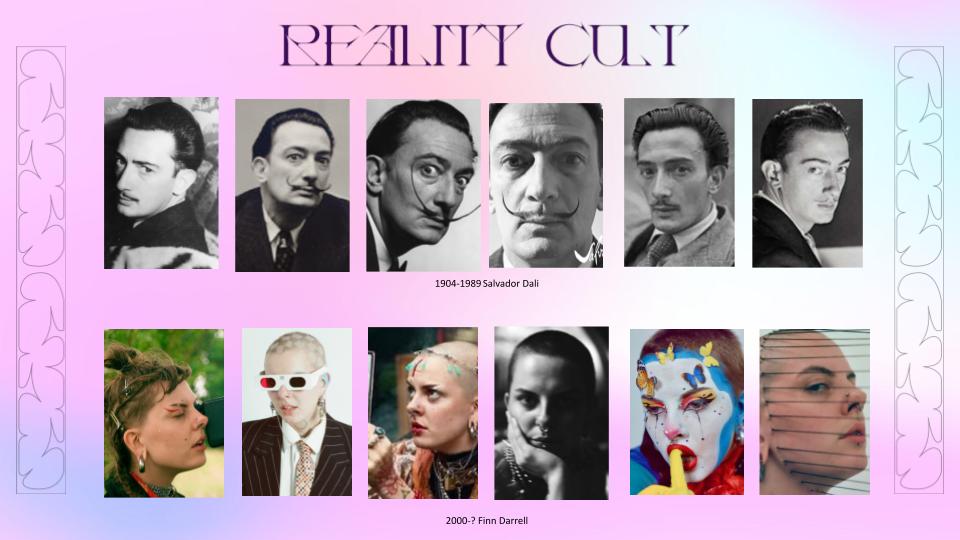
Salvador Dalí → Finn Darrell
Salvador Dalí (1904–1989) was one of the most flamboyant and visionary figures of the 20th century. Painter, filmmaker, provocateur—he blurred the line between dream and waking life, often through erotic, transgressive imagery. Dalí’s canvases and performances courted shock, desire, and the unconscious, turning sexuality into a surrealist theater of revelation.
In this lifetime, that current flows into Finn Darrell, a contemporary artist, filmmaker, and performer whose work fuses myth, esotericism, and eroticism. Their projects, presented at festivals and gatherings like Occulture, range from experimental films to immersive performances, often incorporating sensual and erotic art as a way of breaking through cultural taboos. Through cinema, ritual, and performance, Finn creates dreamscapes where archetype, body, and desire converge. (See examples on Vimeo)
Just as Dalí merged surrealism with erotic shock to destabilize the viewer’s sense of reality, Finn uses erotic performance and film to explore liberation, vulnerability, and mythic embodiment. Both lives share the same archetype: the artist as dream-weaver and provocateur, insisting that imagination and eros are inseparable forces of transformation.
Across lifetimes, the soul’s gift remains consistent: to live at the threshold of dream, sexuality, and art—turning the raw materials of desire into myth, performance, and visionary experience.
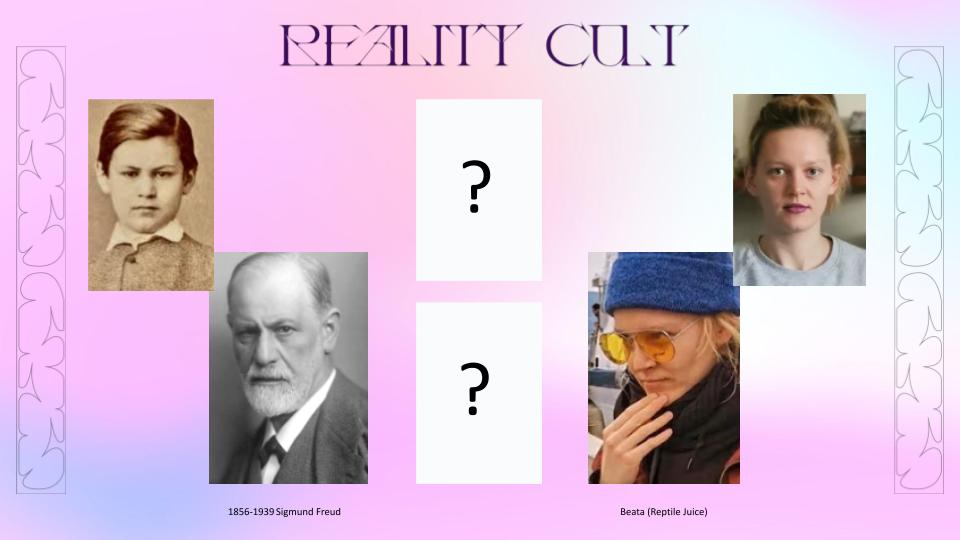
Sigmund Freud → (intermediate life?) → Beata Grobenski
Sigmund Freud (1856–1939), the founder of psychoanalysis, dedicated his life to exploring the unconscious, dreams, and the hidden forces shaping human behavior. His work opened the door for modern psychology, though framed by the limits of his era—rooted in pathology, analysis, and interpretation. Freud’s enduring gift was to make the unseen visible: to show that our inner worlds carry structures as real and impactful as the outer ones.
That same current flows today in Beata Grobenski, an independent researcher affiliated with the Emergent Phenomenology Research Consortium and the Qualia Research Institute. Her work investigates the frontier of consciousness: neural annealing, qualia formalism, emergent phenomenology, and integrating involuntary awakenings into clinical practice. Where Freud mapped the unconscious through talk therapy, Beata builds bridges between neuroscience, phenomenology, and information theory—offering new frameworks for healing and integration. She is currently writing The Good Annealing Manual: From Psychedelic Alchemy to the Chemistry of the Mind (QRI, forthcoming), a guide to emotional well-being, peak experiences, and stress-dissipation techniques.
Interestingly, there are hints of a possible intermediate incarnation between Freud and Beata—perhaps a life more explicitly linked to music and creative expression. This would align with Beata’s current side explorations in music, and with the soul’s pattern of turning inner structures into outward form.
The continuity is clear: Freud unearthed the unconscious through analysis; Beata expands it through science and phenomenology. Whether through psychoanalysis, music, or neural networks, the soul’s task across lifetimes remains the same—to translate hidden inner worlds into frameworks of healing, meaning, and transformation.
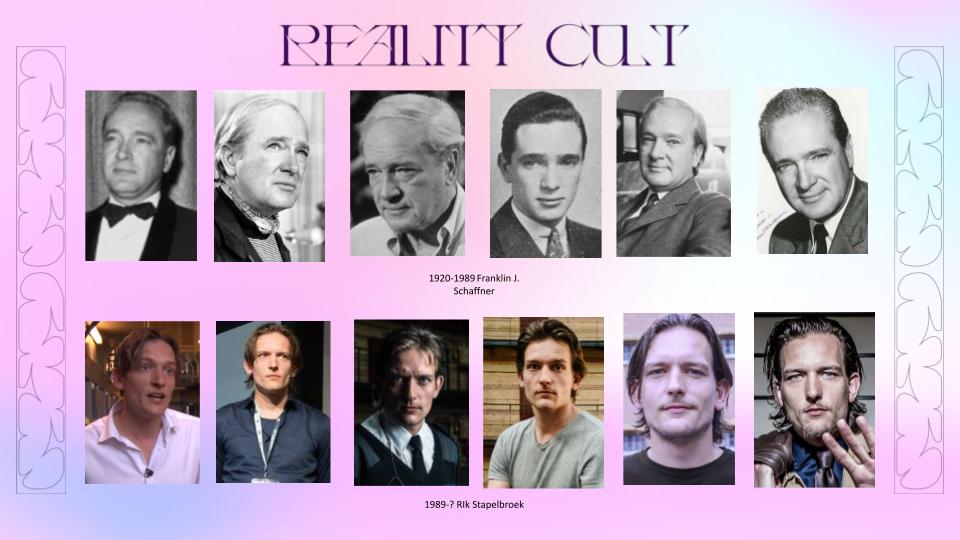
Franklin J. Schaffner → Rik Stapelbroek
Franklin J. Schaffner (1920–1989) was an American film director best known for works like Patton, Papillon, and Planet of the Apes. His films often explored confinement, power, and human resilience under systems of control—whether military hierarchies, prisons, or dystopian futures. His gift lay in creating immersive worlds where the struggle for freedom and identity played out on grand cinematic scales.
That visionary thread now continues in Rik Stapelbroek, founder and creative director of Prison Escape, a large-scale immersive theater experience in the Netherlands. Where Schaffner built films about prisons and power struggles, Stapelbroek has built a living, participatory world where audiences themselves become inmates, plotting their escape within a fully realized environment. His work blurs the line between theater and game design, echoing Schaffner’s ability to fuse story and spectacle into visceral experience.
This karmic resonance extends further: Giek, the reincarnation researcher of Reality Cult, has worked for several years as an actress at Prison Escape—an echo of her own past life as Jim Morrison, who was arrested multiple times and destined for further jail time before faking his death. In this life, the stage of Prison Escape becomes a symbolic arena: what once was literal incarceration transforms into performative play, research, and artistic liberation.
The soul’s task across these lifetimes is clear: to create immersive worlds that confront systems of control, and to invite others to step into the drama of resistance and freedom.
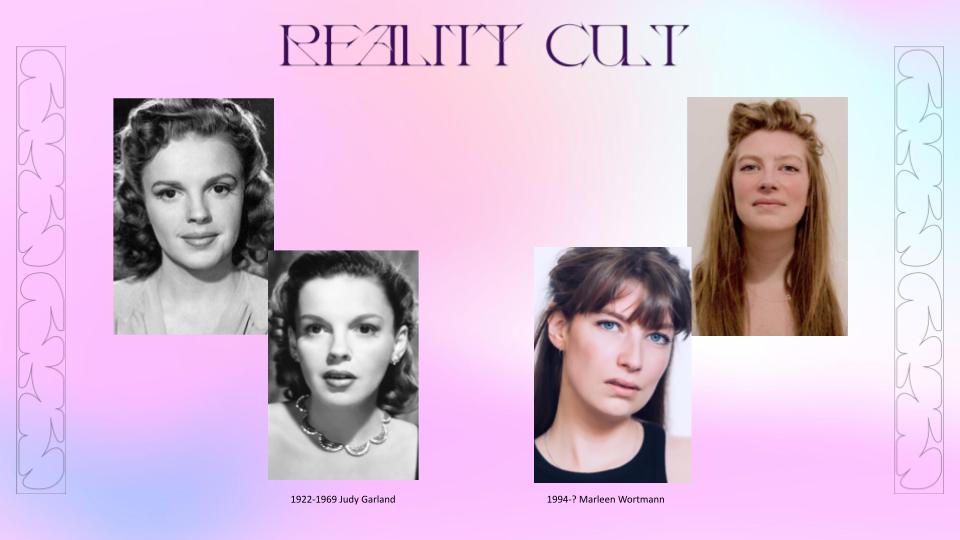
Judy Garland → Marleen Wortmann
Judy Garland (1922–1969) was one of the most iconic performers of the 20th century—an actress, singer, and entertainer whose life was defined by both extraordinary talent and the pressures of living inside carefully scripted roles. On stage and screen she embodied archetypes of innocence, resilience, and longing (The Wizard of Oz, A Star Is Born), while behind the scenes she battled with exhaustion, control by the industry, and the difficulty of separating her true self from the performances demanded of her.
In this life, the soul continues to weave story and performance through Marleen Wortmann, writer, dramaturg, and creative partner in Prison Escape. Marleen studied theater at the Amsterdam University of the Arts and has built a career as a writer of immersive scripts, designing narrative frameworks where participants themselves step into character. Where Garland embodied roles on screen, Wortmann now writes the roles that others perform—an echo of the same creative impulse, shifted from center stage to the architecture of story itself.
Together with her partner Rik Stapelbroek, Marleen shapes the narrative worlds of Prison Escape: blending theater, game design, and lived performance to create experiences that move beyond fiction into reality. Just as Garland’s performances blurred the boundary between public myth and private truth, Wortmann’s writing blurs the line between script and life—participants become “inmates,” actors become guides, and fiction becomes an environment one must navigate.
Across lifetimes, the soul’s task remains consistent: to hold space where human drama can be lived, witnessed, and transformed. From the bright lights of Hollywood to the immersive stages of Dutch theater, the gift endures—story as a vessel for truth, and performance as a mirror of the soul.
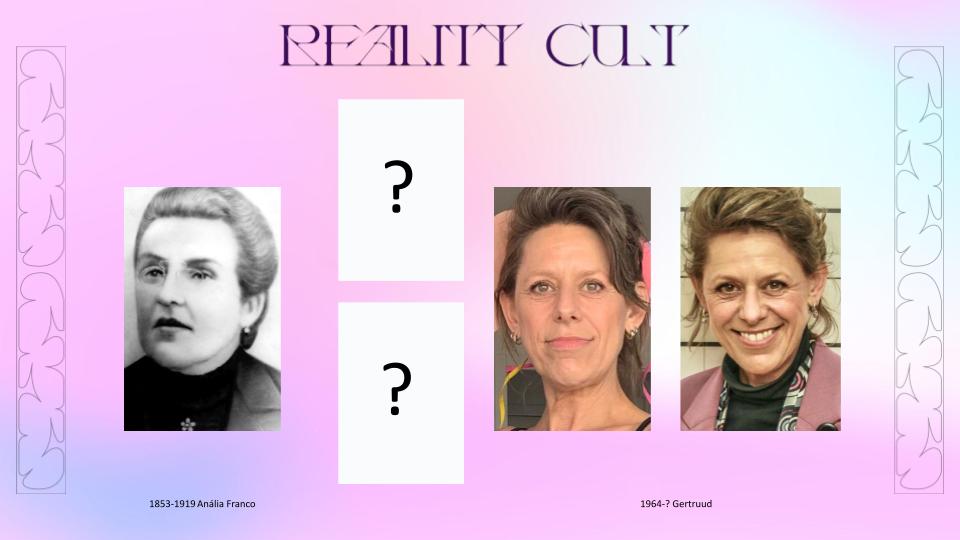
Anália Franco → Gertruud Kocken
Anália Franco (1853–1919) was a Brazilian educator, writer, poet, and social reformer who dedicated her life to children, women, and the marginalized. She founded hundreds of schools, orphanages, and cultural initiatives, believing that creativity, education, and care could transform society. Her mission was both practical and poetic: to nurture imagination as a path to dignity and empowerment.
In our time, this same versatile current flows through Gertruud Kocken, a Dutch creative coach, theater-maker, actress, and educator. Gertruud develops handcrafted theater plays together with children (Delftse Maakweken), works as a culture coach (GA Hilversum), and creates workshops, events, and poetic classes that invite youth and communities to express themselves. She also performs as an actress in Prison Escape, an immersive theater project in the Netherlands, embodying the very spirit of participatory storytelling and transformation through play. (See more here)
The echo between these lives is unmistakable: both women carry a soul-task of weaving art, education, and community together. Where Anália built schools and cultural associations, Gertruud builds participatory theater, creative coaching, and poetic encounters—different forms, same essence. Both embody the belief that creativity is not just for the few, but a right and a gift for everyone, especially the young and the unheard.
Across lifetimes, the soul’s work remains the same: to open doors of imagination and inclusion, creating spaces where art becomes a language of empowerment.
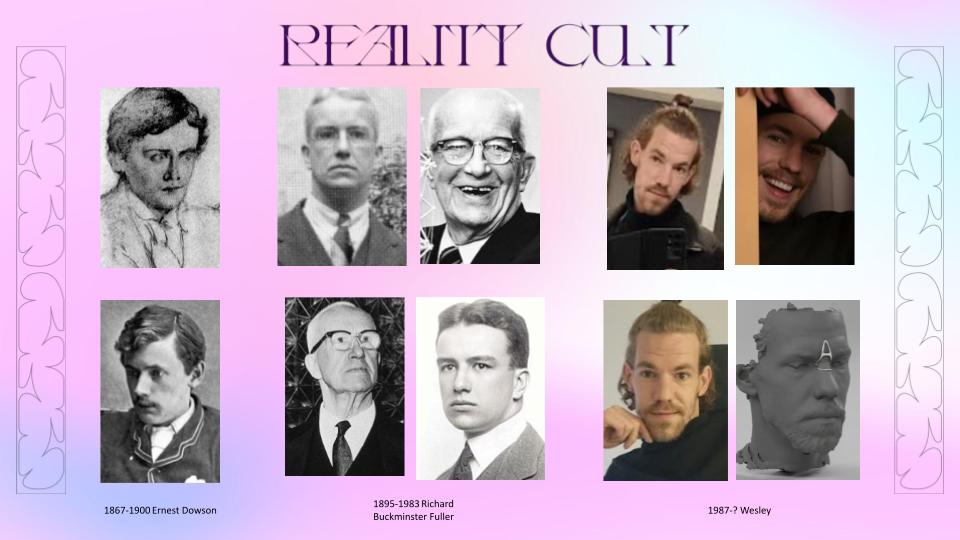
Ernest Dowson → Buckminster Fuller → Wesley Günter Krijntjes
The trajectory of this soul moves from fragile lyricism to radical design, and finally into a synthesis of both.
Ernest Dowson (1867–1900) was a poet of the English Decadent movement, remembered for verses steeped in melancholy and impermanence—“the days of wine and roses,” “gone with the wind.” His short life was marked by illness, poverty, addiction, and despair. This intimate knowledge of fragility and transience seeded a karmic desire for something more enduring. His poetry showed a sensitivity to rhythm and pattern, but lacked the stability he longed for.
That longing found its answer in Buckminster Fuller (1895–1983). Where Dowson experienced impermanence, Fuller sought lasting structures. He became an architect, inventor, and visionary, known for geodesic domes and holistic design principles. Fuller’s philosophy was profoundly metaphysical: humanity as crew aboard Spaceship Earth, entrusted with discovering the Universe’s patterns. The poetic yearning of Dowson re-emerged as Fuller’s quest for cosmic harmony and sustainable order. Fragility gave way to resilience, despair to visionary pragmatism.
In this life, the soul appears as Wesley Günter Krijntjes, a Dutch designer whose 3D-engineered jewelry and interiors carry Fuller’s geometric clarity—even though Wesley began creating without knowledge of Fuller’s work. His designs (see Creative Divisions, Godly Jewls, and Advanced Geometry) echo the same fascination with form, balance, and structure. At the same time, Wesley continues the poetic current of Dowson, writing verse and experimenting with music alongside his design practice.
From verse to domes to digital jewelry, the soul remains faithful to its central gift: shaping intricate patterns that bridge beauty and truth. Each lifetime refines the gift—moving from fragility to durability, from despair to cosmic design, from words to geometry—yet the essential task remains: to find and create harmony in form.
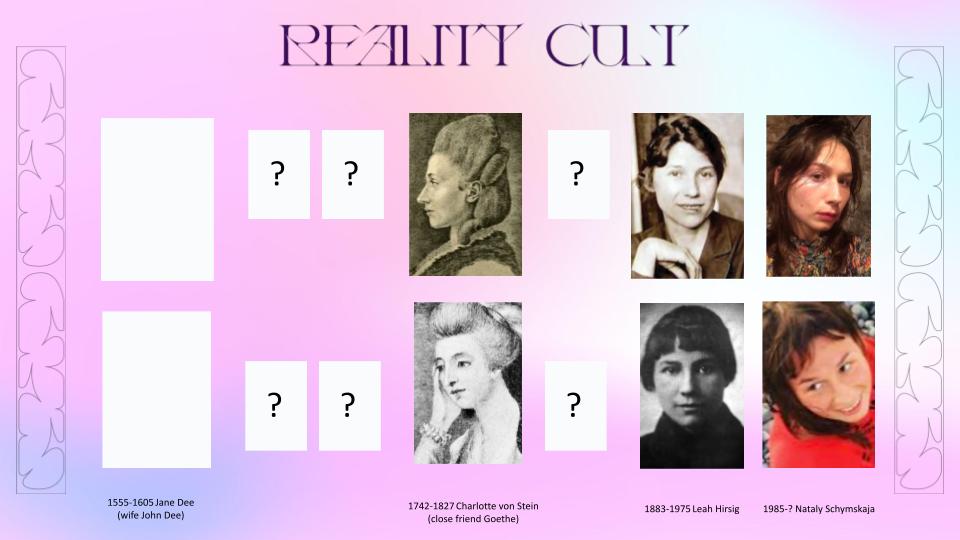
Jane Dee → Charlotte von Stein → Leah Hirsig → Nataliiia (Nataly) Schymskaja
This soul’s journey moves across centuries of esoteric devotion, artistic expression, and initiatory partnership.
As Jane Dee (mid–late 1500s), she was the wife of John Dee, the Elizabethan magus and court scholar. That life was deeply entangled with ritual practice, angelic workings, and the tensions between spiritual pursuit and the earthly demands of family and survival.
As Charlotte von Stein (1742–1827), she entered the cultural world of Weimar as the intimate confidante of Goethe, shaping his emotional and artistic life. Here the soul embodied refinement, sensitivity, and the subtle power of artistic partnership—holding space for creation to unfold in others as well as herself.
As Leah Hirsig (1883–1975), she became a central figure in early 20th-century occultism, most famously as Aleister Crowley’s Scarlet Woman. That incarnation carried forward the theme of initiatory partnership, this time through ritual transgression, devotion, and an uncompromising exploration of the esoteric.
In the present, as Nataliiia (Nataly) Schymskaja, these threads are once again woven together. She is an artist and performer who translates metaphysical knowing into tapestry, drawing, and theater-like performances. Her work moves between textile as ritual object, performance as initiation, and image-making as inner cartography—expressing an ease with esoteric languages and their embodiment in art. (See her work here)
These lifelines also interweave with Giek’s own reincarnational thread: once John Dee, then Goethe, later Charles Jerome Pollitt (twin flame of Aleister Crowley). Across centuries, the two souls continually return to one another—husband and wife, artist and muse, magician and devotee—each time carrying forward the shared task of weaving esoteric knowledge into lived, embodied form.
Together, the echoes form a karmic duet: a long-standing collaboration in devotion, art, and occult exploration, manifesting anew in the friendship and creative resonance of this present life.
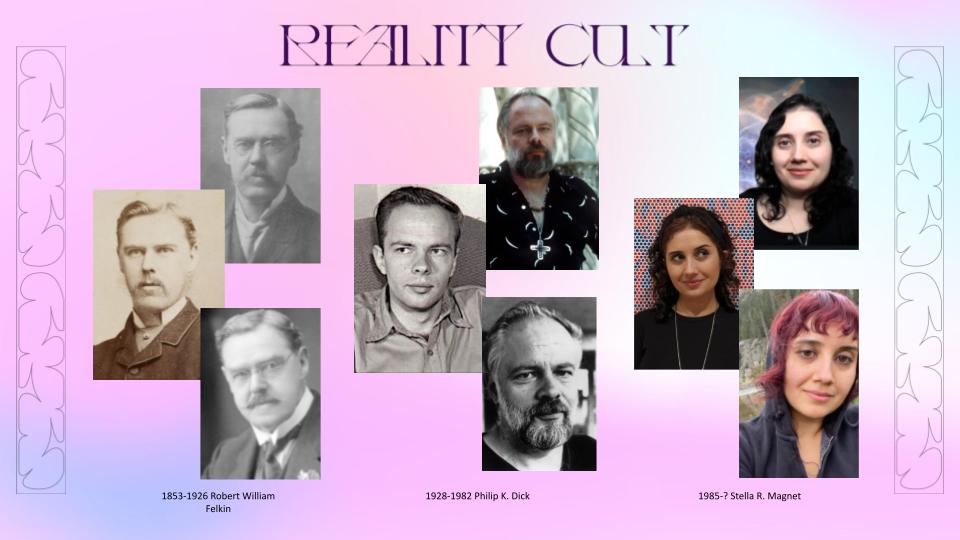
Robert William Felkin → Philip K. Dick → Stella R. Magnet (Yalda Mousavinia)
The thread of this soul runs like a current of initiation, imagination, and visionary truth.
Robert William Felkin (1853–1926) was a doctor, missionary, and occultist best known for his role in the Hermetic Order of the Golden Dawn and for founding Stella Matutina, a magical order dedicated to esoteric knowledge and spiritual training. His work fused ritual, mysticism, and healing—building structures for hidden knowledge to be transmitted.
That same current re-emerged in Philip K. Dick (1928–1982), whose novels blurred the line between science fiction and mystical revelation. Dick explored artificial realities, parallel timelines, and divine encounters—visions that read like modern gnosis. Where Felkin constructed initiatory temples, Dick built narrative universes. Both were driven by the question: what lies behind the veil of reality?
In our time, this soul appears again as Stella R. Magnet (Yalda Mousavinia), a technologist, artist, and community builder who creates decentralized architectures for collective vision. Through projects like Blacksky.network and her work at stellarmagnet.xyz, she pioneers tools for dream research, mental mobility, and future-shaping technologies. The echo is unmistakable: from occult orders to visionary literature to decentralized networks, this lineage continues to design bridges between inner and outer worlds, mysticism and technology, the personal and the collective.
Across lifetimes, the soul’s gift remains the same: to reveal hidden structures of reality and to invite others into the work of transformation.
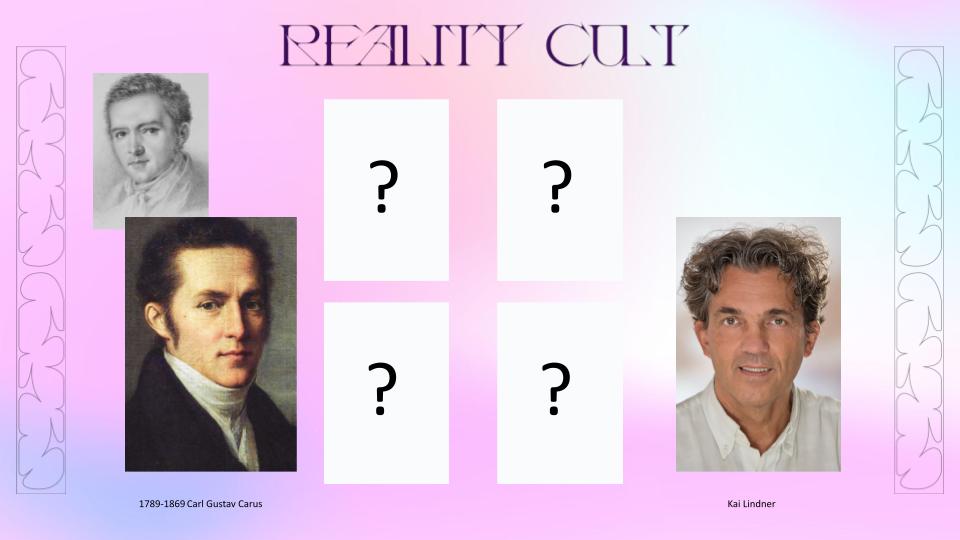
Carl Gustav Carus → (intermediate life?) → Kai Lindner
Carl Gustav Carus (1789–1869) was a German physician, naturalist, painter and philosopher of the Romantic era. He moved fluidly between medicine, landscape painting, and a deep metaphysical curiosity about nature and the soul — looking for the living connections between body, psyche, and the organic world. His work married clinical observation with aesthetic sensibility: healing seen as a form of attunement with life’s patterns.
There may be an intermediate incarnation in this soul-line that still needs to be researched — a bridging life that would help explain how Carus’s Romantic naturalism turned into the particular blend of earth-based healing and astrological practice we see today. This possible life remains to be discovered and could contain clues about the soul’s move from Romantic science into embodied, vocational healing modalities.
In the present, that thread appears in Kai Lindner, a natural practitioner (Heilpraktiker) and astrologer working in northern Germany. Kai’s practice blends hands-on natural healing with an astrological understanding of timing and temperament, echoing Carus’s impulse to unify body, psyche, and the intelligence of nature. (See: Sequoia Schule and Kai’s local practice listing.)
Seemingly spontaneous recognition can sometimes betray deep karmic ties: when Giek met Kai in northern Germany, the two felt an immediate, uncanny affinity — a resonance that maps back to earlier friendship lifetimes, most notably when Giek remembers being Goethe. That felt connection reads like an old chord being struck again: scholar, artist, healer — meeting once more in a different arrangement.
Across these lives the soul’s vocational arc stays consistent: attentive service to embodied knowing, a poetic sensitivity to natural form, and the practice of translating inner patterns into methods of care. From Carus’s Romantic medicine and painting, through an as-yet-unmapped bridge life, to Kai’s modern natural-astrological practice, the gift persists—healing as a form of artistry and knowledge grounded in the living world.
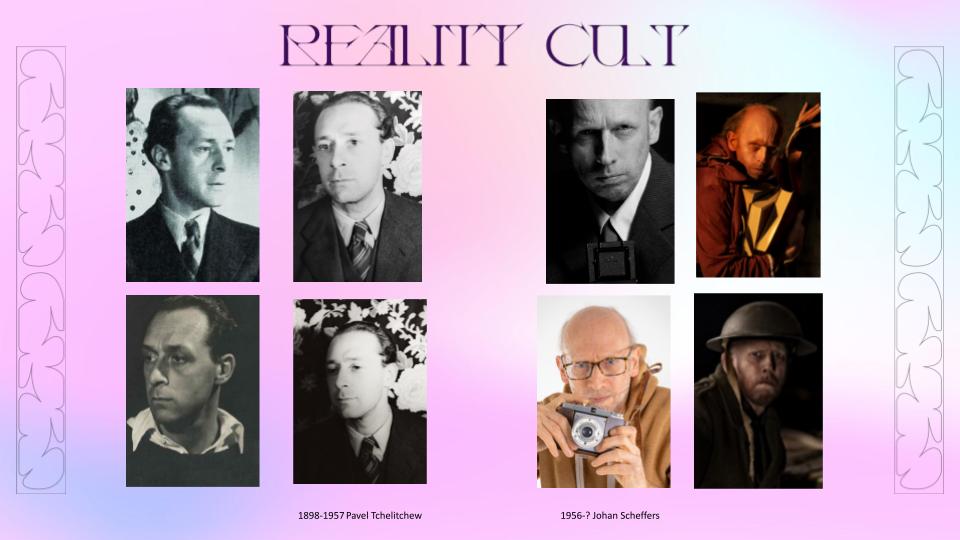
Pavel Tchelitchew → Johan Scheffers
Pavel Tchelitchew (1898–1957) was a Russian-born painter and stage designer known for his surreal, theatrical canvases and set designs. His work fused dreamlike imagery with anatomical precision, often creating layered, visionary worlds that blurred body, myth, and stage. He was fascinated with transformation—figures dissolving into roots, fire, or cosmic landscapes—and was drawn to the theater as a space where painting and performance could meet.
In this life, the same imaginative current is alive in Johan Scheffers, a Dutch photographer who constructs theatrical worlds through his camera. Johan stages elaborate, cinematic scenes—trench workers under dim light, mystics in stone passages, dreamers on the moon—that function like modern tableaux vivants. His photography does not simply document; it directs, crafting immersive moments where the line between history, dream, and performance collapses. (See more of his work here)
Just as Tchelitchew built surreal landscapes on canvas and stage, Johan builds them in light and lens. Both transform figures into archetypes, crafting visual worlds that are at once intimate and theatrical, precise and dreamlike.
Across lifetimes, the soul’s task persists: to conjure visionary realities through art, to stage the dream in tangible form, and to remind us that image itself can be a portal.
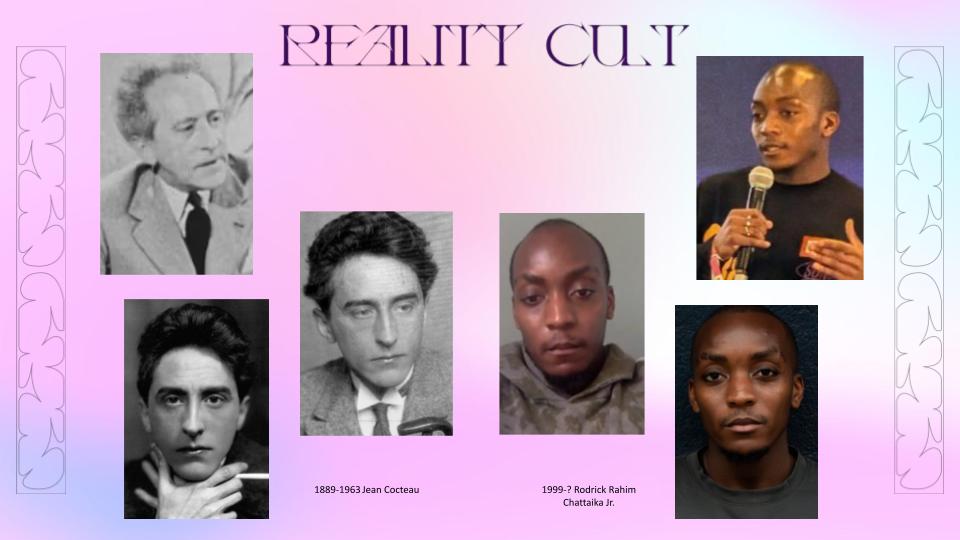
Jean Cocteau → Rodrick Rahim Chattaika Jr.
Jean Cocteau (1889–1963) was a French poet, playwright, filmmaker, and artist whose work blurred genres and media. He lived as a polymath: staging surreal plays, writing poetry, designing sets, and directing visionary films such as Orpheus and The Blood of a Poet. His work was marked by an avant-garde spirit, a self-taught audacity, and the ability to make art from every available medium. Cocteau also knew setbacks—criticism, personal struggles, and rejection—yet always returned to creation, moving fluidly across artistic forms.
In this lifetime, that same restless creativity resurfaces in Rodrick Rahim Chattaika Jr., a self-taught photographer, writer, and visual artist who also ventures into entrepreneurial and collective projects. As co-founder of Peachz, he experimented with creative ecosystems that blend technology, storytelling, and culture. Though setbacks led him to step away from Peachz, his practice continues through writing, visual exploration, and collaborative networks in art and tech. (See more on his LinkedIn).
Like Cocteau, Rahim is drawn to the borderlands where disciplines meet—where poetry becomes performance, where technology becomes culture, where images become myth. His writings (e.g. Cathedrals, Bazaars, Dance Floors Built on Parity) read like modern manifestos, echoing Cocteau’s avant-garde declarations. His photography and visual art carry the same impulse to capture the surreal in the everyday, the poetic in the raw.
The karmic echo is strong: Cocteau and Rahim both embody the archetype of the polymath visionary, driven to create across forms even in the face of disruption and difficulty. Their gift is not just in any single work, but in the way their lives themselves become a canvas—ever searching, ever inventing, ever weaving the poetic into the fabric of reality.
Watch Rahim’s past life reading here.
Leave a Reply